Living in Vicksburg, Mississippi, I have a veritable treasure trove of blogging subjects literally at my doorstep.
One of the most visited sites in Vicksburg is the Vicksburg National Military Park, which commemorates the campaign, siege and defense of Vicksburg during the Civil War.

Vicksburg was a fortress located on high ground guarding the Mississippi River. Its surrender on July 4, 1863, coupled with the fall of Port Hudson, Louisiana, divided the South, and gave the North undisputed control of the Mississippi River. The Vicksburg military park covers 1,728 acres and includes 1,330 monuments and markers, a 16-mile tour road, a restored Union gunboat, and a National Cemetery.
I recently drove through the park and it is impressive. Even if you're not a Civil War buff, I think you would enjoy seeing the scenic views and beautiful bronze monuments, some of which are truly works of art.
I began my adventure by driving the 16-mile tour road, which winds gracefully through the park (you can click on the pictures to enlarge them, if you'd like).


As I drove, I passed through heavily wooded areas with steep slopes and severe drop offs at the edge of the road, and tried to imagine how treacherous the terrain must have been 145 years ago. Here is what it looks like today ...


As I started my driving tour, I knew there was no way I could take pictures of all the markers and monuments in the park, and that was not my intention. I just drove along, stopping when something caught my eye ... and it would have been impossible to pass by the Illinois State Memorial without stopping. Modeled after the Roman Parthenon, the Illinois State Memorial is one of the most impressive monuments in the park.

Stone Mountain, Georgia granite forms the base and stairway, and above the base is Georgia white marble. There are forty-seven steps in the long stairway, one for each day of the Siege of Vicksburg (from May 18 to July 4, 1863). Sixty unique bronze tablets line the interior walls and name all 36,325 Illinois soldiers who participated in the Vicksburg Campaign.
My next stop was at the Wisconsin Monument. A bronze statue of "Old Abe" the war eagle, mascot of the 8th Wisconsin Infantry, sits atop the monument.
As I rounded a curve a little further down the road, this monument caught my attention. At first I thought it had a cross on it, but as I got closer, I realized it was just a stain caused by water running down the rock.

The monument is the Massachusetts State Memorial, and it was the first state memorial erected within Vicksburg National Military Park. It is mounted on a 15-ton boulder from Massachusetts, and the three regiments from Massachusetts are listed on the memorial.
This impressive equestrian statue of General Ulysses S. Grant marks the site of his headquarters ...

I was curious about this little tunnel, which I photographed from two different positions ...


After researching it, I discovered that the Union soldiers in this section of the line were commanded by Brig. Gen. John M. Thayer. They had taken part in two unsuccessful assaults on May 19 and May 22, 1863, advancing up the hill only to be driven back by Confederates positioned at the top.
After the second setback, the Federals began digging a six foot deep approach trench. It was bricked to provide strength and protection from the cannon rounds constantly pounding the road. This tunnel allowed his men to mass in large numbers without being seen across the ridge of the road, and they made a fast dash up the hill, full speed with their guns unloading on the Confederate positions on the top. After several tries, Thayer eventually held the high ground.
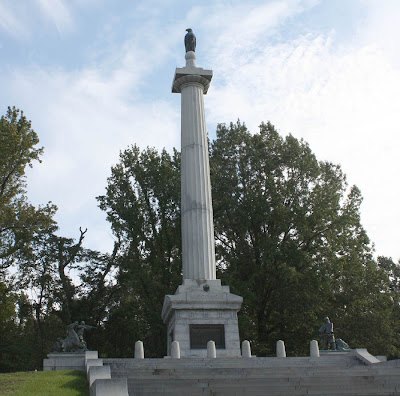
As I wound my way around the tour road, it was hard to miss this awesome monument.

At 202 feet in height, the Navy Memorial is the tallest monument in Vicksburg National Military Park. It is a tribute to the officers and sailors of the U.S. Navy who served in the Vicksburg Campaign.
After leaving the Navy Monument, I came upon the USS Cairo Gunboat and Museum.

In the same year she was commissioned, the Union gunboat USS Cairo had the dubious distinction of being the first armored vessel in the history of warfare to be sunk by an electrically detonated torpedo, today called a mine.

On December 12, 1862, in the Yazoo River approximately 10 miles north of Vicksburg, Cairo was struck by two torpedoes, sinking in less than 12 minutes with no loss of life.
After 102 years beneath the muddy waters of the Yazoo River, Cairo was raised in 1964, by a group of private citizens who called themselves "Operation Cairo."
Currently on display within the Park, Cairo is the only surviving vessel of her class.


Original guns and carriages are mounted on the vessel. Visitors to the site can walk aboard a reconstructed portion of the gun deck and view the original engines, boilers, pilothouse and remaining iron. Adjacent to the outdoor vessel exhibit, the Cairo Museum exhibits smaller items recovered from the boat such as sailors' personal possessions, cookware and weaponry.
The beautiful, yet solemn, Vicksburg National Cemetery lies next to the USS Cairo Museum.

The cemetery was established in 1866 to honor Union soldiers who died during the campaign. The remains of only about 5,000 of the 17,000 soldiers buried here have been positively identified.
Confederate soldiers who died at Vicksburg are buried in the Cedar Hill Cemetery (to read more about Cedar Hill Cemetery, please see my post called, "In the Arms of the Angels."
Here are some pictures I took in the cemetery ...


I love trees and this ancient magnolia caught my eye, especially the roots which were wrapped around some of the grave markers ...

I loved its limbs, too, which were twisted and covered with lichen and fern-like plants ...


This "gun monument" was erected in the cemetery on April 13, 1874, and the plaque reads: "Vicksburg National Cemetery, established 1865, Interments 16,586, Known 3,629, Unknown 12,957."

As I drove out of the cemetery, I saw these pretty spider lilies growing along a brick wall beside the road ...

As I snapped the spider lily picture, I got a glimpse of this flag fluttering in the breeze and happened to catch it unfurled ...

The road continued to wind upward from the cemetery to a bluff known as "Fort Hill."

Overlooking the Mississippi River, Fort Hill was the anchor of the left flank of the rear Confederate defense line. The fort's position was so strong that the Union Army did not even attempt an attack when the assaults of May 19th and 22nd were carried out.
From the bluff you can see forever ...

This is the Port of Vicksburg, which is on the Yazoo River diversion canal ...

A photo tour of a military park wouldn't be complete without a picture of a cannon, and here are a couple that were on Fort Hill ...

This one was manufactured by Steen, and was dated 1862 ...

"A Big Gun! 
Across from Fort Hill, was this pretty and intriguing driveway ...

As I took the picture of the driveway, I got just a glimpse of red brick and white columns, and so wanted to get a good picture of the house, but couldn't without trespassing, darn it.
By now, it was afternoon and I was rather tired after my morning of exploring tunnels, and climbing all those redoubts (a protective barrier, usually constructed of dirt) and monument steps, so I finished my driving tour by taking a few more monument pictures ...


This is the Missouri Monument ...

The Mississippi Monument ... 
It is a beautiful memorial, but I have to admit that I was disappointed that it doesn't have any kind of identification, except for this plaque which you can't read until you get close to it ...

The bronze work represents various actions of the Mississippi troops during the Siege of Vicksburg. At the center of the monument is a statue of Clio, the "Muse of History" ...


Louisiana ...

I love this pelican and its babies ... 
Arkansas Memorial ...

The Alabama State Memorial ...

Georgia ...

The Iowa State Memorial ...

After I finished the driving tour, I decided to stop by the Visitor's Center and take a few pictures inside.
This beautiful oil painting of the Cairo hangs in the lobby
(Unfortunately, I didn't get the artist's name)
 The Generals and Their Swords
General Ulysses S. Grant and General John C. Pemberton ...
General John C. Pemberton, the Commander of the Confederate Army at Vicksburg, was a native of Philadelphia, Pennsylvania, and a West Point Military Academy graduate. It was because of the influence of his Virginia born wife and many years of service in the southern states before the Civil War, that he became devoted to the South. Pemberton was made a Lieutenant General in the Confederate Army and assigned to defend Vicksburg and the Mississippi River.

Upon Vicksburg's surrender, he voluntarily resigned his commission and served as a lieutenant colonel of artillery for the remainder of the war, a testimonial of his loyalty to the South.

After the siege, Confederate President Jefferson Davis wrote to Pemberton, "I thought and still think you did right to risk an army for the purpose of keeping command of even a section of the Mississippi River. Had you succeeded, none would have blamed, had you not made the attempt few would have defended your course."
Jefferson Davis won lasting fame as President of the Confederate States of America. He was a graduate of West Point Military Academy and a veteran of the Mexican War where he earned the rank of Colonel. Davis then served terms as a United States Senator and was Secretary of War under President Franklin Pierce.
When Mississippi seceded from the Union, Davis returned to his plantation a few miles south of Vicksburg. While at his plantation he received news that he was elected President of the Confederacy. After the war, he returned to Mississippi and lived the rest of his life at Beauvior on the Mississippi Gulf Coast.
The Jefferson Davis Memorial ... 
As I was leaving the visitor center, I stopped to browse through the shelves of books about the Civil War, and was amused to find this one ...

Judging by the number of books still on the shelf, it's not one of their best sellers.
I apologize for the length of this post, and if you are still here to read this, I appreciate your reading all of it. Although I'm not really a Civil War "buff," I enjoyed touring the park and capturing a small part of its history in my photos.
For more information about the Vicksburg National Military Park, please visit the web site.
Sincerely,


