Showing posts with label Photos of Rodney MS. Show all posts

Monday, January 24, 2011

Rodney Postscript

Last week, I shared a recent trip I made to a place called Rodney, Mississippi. The purpose of this follow up is to "tie up some loose ends."

If you missed the first chapters of my story, you may want to read them before you read this last one (I promise, it really is the LAST one).

A Place Called Rodney

The Rise and Fall of the Rodney Presbyterian Church

A Visit to Rodney, MS: The Cemetery

In my previous posts, I forgot to include my pictures of what remains of another old building in Rodney — the Alston Grocery Store. I'm sure that during its heyday, the old general store was the center of activity in the little community. It was opened by the Alston family in 1915, but has been closed for many years.

Here is what remains of the store today ...

I love the rusty old gas pump, and can just imagine the stories it could tell about the townspeople who lived during that era of Rodney's history — if only it could talk!

Down the road a little and across the street from the grocery store are these dilapidated buildings, one of which I believe was a drugstore.

Due to the interest expressed by several of my readers, I would also like to take this opportunity to share a few additional facts about Rodney's history, which I purposely omitted in my previous posts, for the sake of brevity.

Rodney was originally settled by the French in 1763, and named Petit Gouffre meaning "Little Gulf." The town was later renamed Rodney in 1828, in honor of Judge Thomas Rodney.

Thomas Rodney was born June 4, 1744, to a wealthy family with political ties. He served as a Continental Congressman from Delaware, and a Justice of the Delaware Supreme Court until 1803, at when President Jefferson appointed him as the chief justice for the Mississippi Territory. Judge Rodney bought land in what was then Jefferson County, Mississippi, and moved to Natchez to assume his new duties as the senior federal judge for the Mississippi Territory, from 1803 to 1811. Judge Rodney died January 2, 1811, at Natchez. He was the younger brother of Caesar Rodney, Revolutionary President of Delaware, who was one of the signers of the Declaration of Independence.

During its heyday, Rodney was host to many notable visitors, including Andrew Jackson, Henry Clay, and Zachary Taylor. Taylor was so taken by the area that he purchased Cypress Grove Plantation, complete with 81 slaves, in 1842.

I found it interesting that it was around this time that Taylor's daughter, Sarah, eloped with Lt. Jefferson Davis, much to her father's dismay. In 1861, Jefferson Davis would become President of the Confederacy.

Although Rodney entertained some important political figures, one of its own residents made quite a name for himself. Dr. Haller Nutt, a native of Virginia, came to Rodney in 1815. Dr. Nutt was a successful cotton planter and plantation owner in Mississippi, and developed a strain of cotton that would lead to the South's becoming the cotton kingdom of the world. He also improved Eli Whitney's cotton gin by connecting the gin to steam power.

Haller Nutt became a very wealthy man, and he and his wife Julia had 11 children. In 1860, Dr. Nutt began construction on Longwood Plantation in Natchez, and that's another story I would like to tell someday.

If you are ever in the Vicksburg or Natchez area, I hope you will put Rodney on your "Places to See" list. There are several other Mississippi historical treasures nearby — Port Gibson: The town "too beautiful to burn" during the Civil War; the truly awesome Ruins of Windsor; and, of course, the Vicksburg National Military Park — so, it would be well worth your time to wander off the beaten path to explore them all.

Thursday, January 20, 2011

A Visit to Rodney, MS: The Cemetery

This is the third and final chapter of my story about a place called Rodney, Mississippi. If you missed the first two chapters, I suggest you read them before reading this one.

Chapter 1: A Place Called Rodney

Chapter 2: The Rise and Fall of the Rodney Presbyterian Church

Today, we're going to take a hike up the hill behind the Presbyterian Church to the Rodney Cemetery (notice I used the word hike, as opposed to walk).

The hill is very steep, the path, rough and heavily-rutted, but if you enjoy exploring old historic cemeteries, it is worth a little huffing and puffing along the way to see this one.

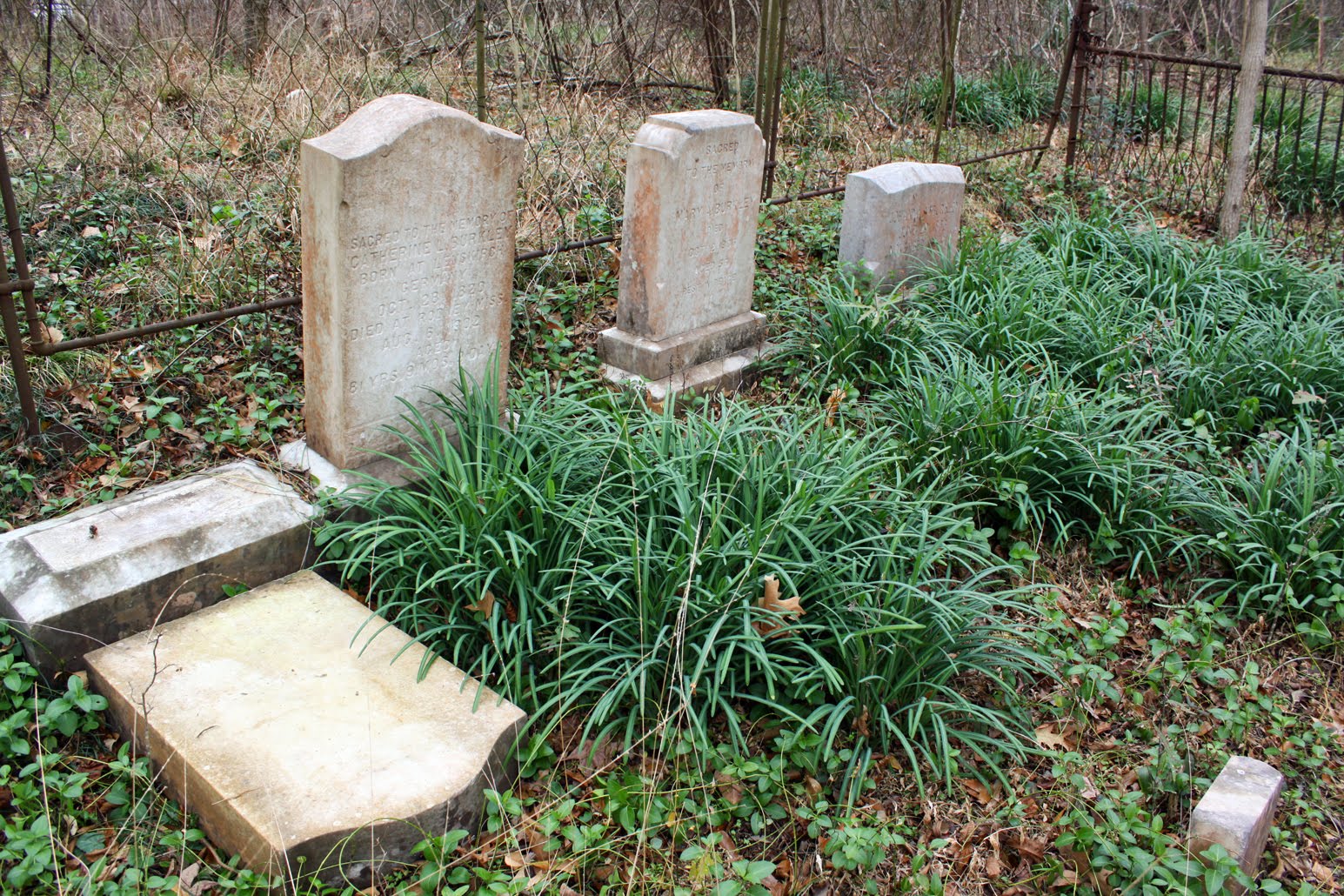
My husband has back problems and didn't attempt the climb, and as I reached the top of the hill I have to admit that it felt a little eerie to be alone in the cemetery, which was overgrown and desolate. It was a dreary day, too, which didn't help matters.

I can't think of a better word to describe what I saw than the word desolate, which Webster's defines as:

  • Devoid of inhabitants and visitors.

  • Joyless and sorrowful, as if through separation from a loved one.

  • Showing the effects of abandonment and neglect.
  • As I stood on the hilltop, taking it all in, I was saddened to see that such a beautiful and historical place had been abandoned and neglected, its gravestones literally crumbling and sinking into the ground, soon to be hidden forever ...

    But, as I walked around and began taking pictures, I realized that, amongst the ruins and briars and brambles, there was also beauty and a quiet peacefulness underneath those old trees.

    I loved the old iron fences which surrounded the family plots, some plain and simple ...

    Yikes! — look at those spikes!

    And some not so simple ...

    I was disappointed that this manufacturer's plate didn't have a date on it ...

    While carefully trying not to step on any of the graves, I went inside a few of the fences to get a closer look at some of the headstones and inscriptions. The oldest person I found in the area where I was, was a lady named Maggie Welch Burkley, who lived to be 92.

    Here are a few more stones that caught my eye ...

    Julia A. Reitz, 1865-1928
    "A precious one from us has gone,
    A voice we loved is stilled.
    A place is vacant in our home,
    Which never can be filled."

    This lady was born in Germany in 1820, and lived to be 81 years, 9 months, and 9 days old, according to the inscription on her headstone. Wouldn't you like to know what circumstances brought her to Rodney, Mississippi.

    Here are a few more inscriptions I was able to decipher:

    "A kind and noble man has fallen,
    Sweet be thy rest beloved husband and father.
    Angels guard thee until we meet to part no more."

    And this simple, but sweet, epitaph read:
    "We will meet you, darling ... beyond the river."

    Headstones like the next one always make me teary-eyed. This one is for a baby girl who lived for seven months ...

    "Our little darling enjoys the sleep,
    From which none ever wake to weep."

    This last inscription is my favorite (and was the hardest to decipher). As near as I can tell from the date, which is hard to read, the young woman died when she was 23.

    "Sweetly she sleeps, the pure and gentle hearted,
    Where no rude footsteps mar her tranquil rest.
    Sweetly she sleeps, from sorrowing loved ones parted,
    In happy trust on her Savior's breast."

    Isn't that beautiful — that alone was worth the climb up the hill!

    I spent about an hour roaming around the cemetery, but didn't venture too far into the overgrowth.

    There are literally hundreds of graves scattered over the hilltop, most of them hidden amongst the palmettos and briars and wild Jonquils, and I would love to go back some day and visit each and every one of them. I can just picture the hill in the springtime, alive with thousands of colorful wildflowers and dogwoods and redbuds in full bloom. But, unfortunately, springtime also brings poison ivy, snakes, red bugs, and ticks ... so I guess I'll just be content that I was able to see it on that cloudy Saturday in January.

    Even though it was disheartening to see the neglect, I'm glad I could capture some of the beauty of the cemetery during my brief visit. And as I started down the hill, I noticed that the dreariness of the day had lifted, giving way to patches of blue sky and billowy white clouds.

    And waiting for me at the bottom of the hill was this cheerful little clump of Jonquils ...

    And this cute little guy who was happily clamoring at my feet while I was taking a couple of shots of the church with the blue sky in the background ...

    Though nothing can bring back the glory days of Rodney, I'd like to think that its story will have a happy ending.

    I understand that The Rodney Center Historic District and the Rodney Presbyterian Church are listed on the National Register of Historic Places ... so, perhaps, there is still hope that someday funds will become available to restore what is left of Rodney. I just hope it won't be too late, and all that will remain is a paragraph or two in history books and a few sad, ramshackle old buildings fading away at the end of a dirt road in Jefferson County, Mississippi.

    Tuesday, January 18, 2011

    The Rise and Fall of the Rodney Presbyterian Church

    This is Chapter Two of my story about a trip my husband and I recently made to a place called Rodney, Mississippi. If you missed Chapter One and would like to read it before you read this post, you can click here.

    The most famous story about Rodney comes from the Civil War era and took place at, of all places, the Rodney Presbyterian Church. This is how the story goes:

    After the fall of Vicksburg, the Union Navy was left in charge of the Mississippi River. The gunboat Rattler was stationed in front of Rodney to monitor things in the important river town.

    One of the favorite pastimes of the men on board was to line the decks on Sunday mornings and watch the southern belles as they paraded into church. The admiral had left strict orders that no one was to leave the ship, but on September 12, 1863, 24 of the sailors, including a lieutenant and captain, could stand it no more. Just before services began at the Presbyterian church, they came in, dressed in their best uniforms, and quietly seated themselves in the congregation.

    As the second hymn was being sung, a Lt. Allen of the Confederate Cavalry walked up the aisle to the pulpit. Apologizing to the Reverend Baker, he turned and announced that his men had surrounded the building and demanded the Yankee sailors surrender. One of the Yankee sailors jumped behind a door and took a shot at Lt. Allen. General melee' broke out and most of the citizens dove under their pews for safety. One Yankee sailor hid in the undergarments of his local southern girlfriend. One older lady, however, would not run. She stood on her pew and shouted "Glory to God!"

    A skeleton crew had remained on board the Rattler, and when they heard the commotion, began firing their guns at the church. The church and four homes were hit (more about this later).

    When the dust cleared, the Rebels had taken 17 prisoners, including the lieutenant and captain. Ordinarily, the Yankees would have burned down the town, but Lt. Allen sent word stating that "the people of Rodney were in no way responsible for what my men have done, and if a solitary shell is thrown into the town, I will proceed to hang my prisoners." The crew of the Rattler became the laughingstock of the nation, for it was the first time in history a small squad of cavalry captured the crew of an ironclad gunboat.

    Now, let's back up to the part about the "church and four homes being hit." One of the cannonballs did, indeed, hit the church — and as much as I would like to say that the cannonball in the following picture is the original cannonball still lodged in the brick wall of the church, local history tells us that this cannonball was placed there many years later after the original one had "fallen out."

    As a southerner, born and bred, I love that story, even if that isn't the original cannonball lodged in the church.

    When I was taking pictures of the church, I didn't know that story, but I could feel the history surrounding it, and wished that those old bricks could talk. Unfortunately, they can't, so I had to do some research to uncover its history.

    In 1828, Jeremiah Chamberlain, a young Presbyterian minister from Pennsylvania, came to Mississippi as a missionary, locating in Rodney. His first step was to organize a church. The present church building was built from 1830-31, and was dedicated on January 1, 1831.

    I found it interesting that the bell in the bell tower was cast with the inclusion of 1,000 silver dollars that were donated by church members.

    Can you imagine the congregations of all those Sundays past for whom that old bell tolled?

    Around 1870, the Mississippi River, which was Rodney's lifeblood, began a gradual change of course. Cut off from the river and hurt by the decline of the cotton trade after the War, the town slowly began to die — and along with it died the congregation of the Presbyterian church. By the turn of the century, Rodney's population had declined considerably, and in 1923, the church, with a congregation of only sixteen members, lost its last full-time pastor.

    The Mississippi United Daughters of the Confederacy obtained the building in 1966, receiving a grant to restore it. Since then, however, funds to maintain Rodney Presbyterian have been low, and the building, among the oldest surviving churches in Mississippi, was listed in the 2003 "Top 10 Most Endangered" sites. There is a plaque on the front of the church commemorating a "Restoration Dedication" in 1990, but I'm not sure what restorations were done at that time. I was encouraged to see this update about the church on the Mississippi Heritage Trust website: "2009 Update - In Progress: The Rodney Foundation, current owners of the property, is presently reorganizing and gearing up for fund raising."

    I wish them well, because everywhere I looked I saw evidence of the toll time and the elements have taken on the beautiful old church.

    You can't go inside the church, except by appointment only through the United Daughters of the Confederacy, but I did manage to capture a picture of the pulpit through one of the windows. I love the way the sky and trees were reflected in the glass.

    I thought I was going to be able to feature both the church and the old Rodney Town Cemetery in this post, but I'm going to have to save the cemetery until next time. I have so many pictures I want to share and haven't had time to go through them yet.

    I hope you enjoyed seeing my pictures of the church and hearing its story.

    Hopefully, one day that story will have a happy ending ... when the Rodney Presbyterian Church is restored to its former glory ... and that old bell in the bell tower tolls once more.