
Those are snapdragons in my header picture. I planted them on March 7, 2012, and I am so ready to start digging in the dirt again.
The growers were hit hard this winter, and the local nurseries are suffering too. Their stock is way down and the plants they have on hand were bitten back by the extremely cold temperatures. Even Home Depot doesn't have anything, except for some straggly Pansies and a few Cyclamens.
I guess I'll just have to be patient for a little longer ... but in the meantime, I'd like to reminisce of springtimes past by sharing pictures of some of the flowers I planted.
Lavender Lantana, May 2013

Sunpatiens, May 2011

Home Depot Mix, April 2009
 
Red Verbena, April 2007
 I hope Mother Nature is being more cooperative where you live ... and I wish you a March filled with many happy hours spent digging in the dirt, with visions of Spring flowers dancing through your head! |
Showing posts with label Sunpatiens. Show all posts
Showing posts with label Sunpatiens. Show all posts
Friday, February 28, 2014
Visions of Spring

Wednesday, May 22, 2013
A Gardener at Heart
I love puttering and piddling and playing with plants and flowers, but I have to confess that I'm not much of a gardener. I truly love plants and flowers and enjoy digging in the dirt and planting them, but I don't have the patience it takes to fertilize, or re-pot, or prune, or spray for insects and diseases, and all the other things that separate the dedicated gardeners from people like me. I guess my little "Grow dammit" sign pretty much sums up my philosophy of gardening.

I just want my flowers to grow and be happy and make pretty blooms and not lose their leaves or turn yellow or brown or wilt. Is that too much to ask?
A couple of weeks ago, I bought a pretty pink Knockout Rose, and it bloomed beautifully ... for about a week.

When I noticed it wasn't blooming as profusely, I moved it out into the courtyard where it would get more sun. But it has been steadily going down hill, and looks as if it has been literally "knocked out" and is down for the count.

I'll give it a couple of weeks and if it doesn't perk up, I'm afraid it's going to end up on "death row," which is where I put the plants that don't survive my "tender loving care."
On a brighter note ... I'm pleased to say that I actually have quite a few survivors. Like this ivy plant ...

It sits on a table on our porch and makes me smile every time I see it and its little bird friend.
This primitive little wooden birdhouse planter was the container for a Mother's Day bouquet from my sweet husband ...

I added a clump of ferns in a clay pot and, I ask you ...
does it get any cuter (or simpler) than that!

Fortunately, considering my lack of gardening skills and gardener virtues, I've discovered that you don't have to spend a lot of money on exotic plants to add interest to your landscaping.
This "grocery store" palm plant is nestled amongst a couple of stone birds on a table beside our porch door, and seems to be quite content with just a drink of water every now and then ...


My daughter gave me the pretty copper and aqua planter shown below for Mother's Day, and I love the way the coleus plants perfectly complement the colors of the planter ...

So far, so good ...
Red Impatiens make a pretty contrast with the verdigris armillary on this little garden cart. I have to water them every day or they will wilt (not a good prognosis of things to come?).

Lantana is a great cascading plant for large urns and is practically maintenance-free.


I am "into" lime green this spring, for some reason, and spray painted an old urn that had red Sunpatiens planted in it (I kindly covered the flowers with a plastic bag, in case you're wondering). I like the combination of lime and red ...

I also added Sunpatiens to this planter beside the path leading from the courtyard to our backyard ...
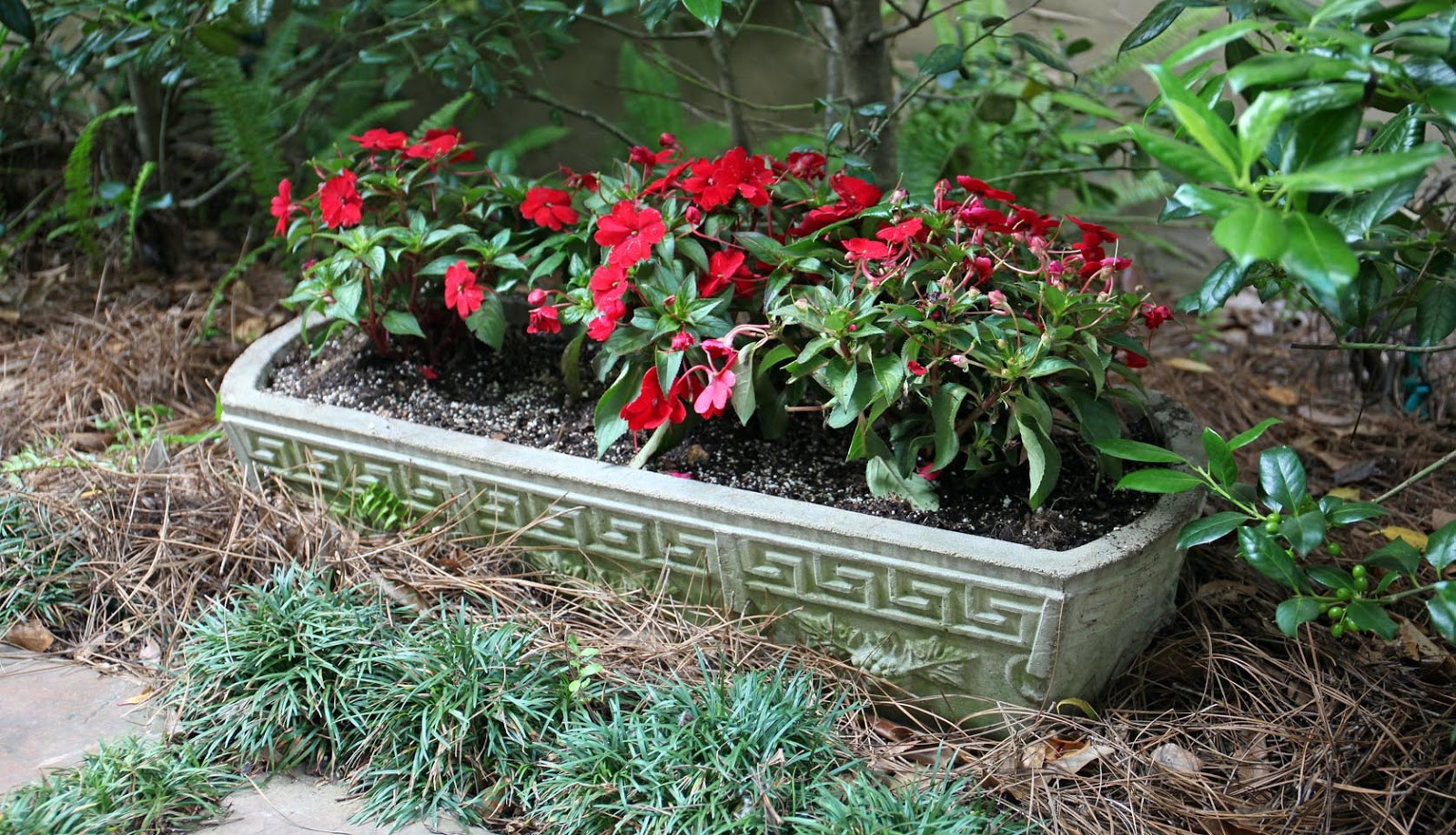
I can see the planter from our bedroom window, and I love opening the blinds in the morning and being greeted by those pretty red blooms. I just hope they survive the long, hot summer that's fast approaching.
Simple ornamental grass plants in urns or pots are easy to take care of and can fill a space where you need a little something extra. Variegated liriope looks elegant in this footed urn with a small iron trellis.


I'm terrible about throwing away the tags that come on plants (something a true gardener would never do!), and I don't know what kind of plant this is ... I know it's some kind of lily grass, but can't remember the name.

I bought it last winter and was so pleased that it survived. Another one that just needs water to be happy.

I hope I haven't given the impression that I don't love gardening ... because I do enjoy it, very much. I am in my glory when I'm digging in the dirt and "tending" my flowers ... it's like therapy and one of my most favorite things to do when I'm not out taking pictures. In fact, I've tried to instill a love of gardening in our granddaughter Avery Grace, since she was old enough to know what a flower is. Here she is helping her great-granddaddy plant tomatoes when she was four ...

And planting Morning Glory seeds when she was five ...

I have a very special gardening project that I'm looking forward to doing with Avery this coming weekend. So, perhaps, I am a gardener, after all ... at heart, if not in the most literal sense. And isn't that even better?

Friday, May 10, 2013
Just a Little Lagniappe
Storm clouds moved into Vicksburg late yesterday afternoon, and I took advantage of the "calm before the storm" to capture some pictures around our yard.
The rose vine on the arbor leading from our front courtyard to
the backyard is covered with pastel pink roses ...

I think I'll cut these buds today and make a bouquet for Mother's Day ...


I bought some flowers at Home Depot this week and they
seem to be happy in their new home ... so far.
Red Impatiens

Pink "Knock Out" Roses ...


My "hand-me-down" garden cart holds red "Sunpatiens" (Impatiens that will tolerate sun),
a yellow Primrose, and a pot of pink English Daisies ...


I hope the flowers will do well. I think it's going to be a long, hot summer here in Mississippi.
The focal point of our courtyard is a small waterfall. I love the sound of the water running over the rocks, and it is home to several little night creatures that serenade us all night.

Our "Midnight Black Elephant Ears" are coming back nicely. They will stand two to three feet tall by the end of the summer.

Midnight Elephant Ears love very moist soil, and are perfect plants for ponds and water features. They prefer sun to partial shade.
I love armillary spheres and found this one several years ago at a Mexican Pottery market in West Monroe, Louisiana (home of the Duck Dynasty guys, if you're a fan).

Harry the Heron, is looking a little faded around the edges these days, but I think it just gives him character ... and he seems to be quite happy and content in his home amongst the pond grasses.


Best wishes to you for a memorable and peaceful Mother's Day weekend filled
with love and lots of sweet memories-in-the-making with your loved ones.
We're going to have our family all "under one roof" (ours!) to celebrate our granddaughter Avery's 8th birthday Saturday, and Mother's Day on Sunday.
Happy Mother's Day, Mama ...
I love you and Daddy more than words can ever say.

November 2010
Saturday, April 30, 2011
From 2011: "An Earthworm Story"
The recent rains and winds we've been having here in Mississippi finally took their toll on some of my Snapdragons. A week or so ago, they looked like this ...

After each battering by rain and wind, they became more and more bedraggled, and finally got to the point that they couldn't straighten back up. Poor things ... yesterday, I took them out of their misery and pulled them up and transplanted them in one big clump in the backyard.

Before I pulled them up, though, I cut some blooms and stuck them in a glass and put them on a table under our porch.

My "stick-in-a-glass-or-jar" bouquets usually turn out better than the ones I try to arrange, and I'm sure we'll enjoy these pretty Snaps all weekend.
I replaced the Snapdragons with a few Sunpatiens, and love the color they added to the courtyard.

While digging the holes to plant the flowers, I disturbed quite a few earthworms, and stopped to watch as they wiggled and burrowed their way back under the dirt. As I watched them, I couldn't help but wonder if my probings with my trowel hurt them, or if the bright sunlight hurt their eyes ... or if they even have eyes!
The more I thought about them, the more curious I became, and after doing a quick Google search, I came across the University of Illinois Extension's website, which provided some interesting facts about earthworms (comments in bold are mine).
- A worm has no arms, legs or eyes.
- An earthworm can grow only so long. A well-fed adult will depend on what kind of worm it is, how many segments it has, how old it is and how well fed it is.
- There are approximately 2,700 different kinds of earthworms.
- Worms live where there is food, moisture, oxygen and a favorable temperature. If they don’t have these things, they go somewhere else.
- In one acre of land, there can be more than a million earthworms.
- The largest earthworm ever found was in South Africa and measured 22 feet, from its nose to the tip of its tail. (That makes me shudder to think about it!)
- Worms tunnel deeply in the soil and bring subsoil closer to the surface, mixing it with the topsoil. Slime, a secretion of earthworms, contains nitrogen. Nitrogen is an important nutrient for plants, and the sticky slime helps to hold clusters of soil particles together in formations called aggregates.
- Charles Darwin spent 39 years studying earthworms more than 100 years ago.
- Worms are cold-blooded animals.
- Earthworms have the ability to replace or replicate lost segments. This ability varies greatly depending on the species of worm you have, the amount of damage to the worm, and where it is cut. It may be easy for a worm to replace a lost tail, but may be very difficult or impossible to replace a lost head if things are not just right. (I can't help but wonder what the "right conditions" are for replacing a lost head)
- Baby worms are not born — they hatch from cocoons smaller than a grain of rice.
- The Australian Gippsland Earthworm grows to 12 feet long, and can weigh 1-1/2 pounds (That sounds too much like a snake to me!)
- Even though worms don’t have eyes, they can sense light, especially at their anterior (front end). They move away from light and will become paralyzed if exposed to light for too long (approximately one hour).
- If a worm’s skin dries out, it will die.
- Worms can eat their weight each day.
I learned a lot about earthworms as a result of my research, and I also discovered that there's no way you can capture a pretty picture of a worm (or at least, I couldn't). But that didn't keep me from trying.
One little worm was especially gregarious, and stopped wiggling and burrowing long enough for me to get a few closeup shots.

Unfortunately, in most of the pictures, he looked more like a little snake than an earthworm (shudder, again!), and he was slimy and covered with dirt (well, after all, he was an EARTHWORM, right?).
To make matters worse, I couldn't tell which end was his head and which was his tail, but figured he would be burrowing with his head, so I focused on the "burrowing end."
In this picture, I was trying to get a close up of his "face" to see if he had eyes (he didn't) ...

And in this one, you can see his segmented body which contracts to help him burrow under the dirt.

Poor little thing ... he's probably burrowed his way halfway to China by now to escape my trowel and zoom lens.
But I'm glad I had the opportunity to satisfy my curiosity about earthworms, and I like knowing that they are busy at work in my flowerbeds burrowing and loosening the dirt so my flowers can flourish.
And to leave you with a pretty picture for the weekend, here's another one of my "bouquet."

Subscribe to:
Posts (Atom)


