
Way, way, WAY off the beaten path of US Hwy. 61 South between Vicksburg and Natchez, in the rural hills and backwoods of Jefferson County, Mississippi, are the crumbling remains of a town which was once a thriving and bustling center of commerce and culture on the Mississippi River — a place called Rodney.
Rodney was founded in 1828, but it was in the 1840's and 1850's — during the heyday of steamboats and cotton — that Rodney became one of Mississippi's most prosperous towns and the busiest river port between New Orleans and St. Louis. In fact, it missed being named the capital of Mississippi by three votes. By 1860, the town had approximately 4,000 residents, and was home to two banks, two newspapers, 35 stores, a large hotel, an opera house, and several saloons.
But, sadly, Rodney's days of prosperity were short-lived. By 1863, the Civil War was raging through Mississippi, and Rodney's economy collapsed, its homes plundered. In 1869, tragedy struck and the town was almost completely destroyed by a fire. But the greatest and final blow contributing to its downfall was dealt by Mother Nature herself when, sometime around 1869, the course of the Mississippi River began to change, leaving Rodney high and dry. Cut off from the river traffic that had been its lifeblood, Rodney's fate was sealed, and it began to die a slow death.
In 1930, Mississippi Governor Theodore Bilbo issued an executive proclamation abolishing the town, but if you don't mind traveling WAY off the beaten path and dodging a few potholes along the way, you can visit what remains of Rodney today.
This past weekend, my husband and I did just that ... and, although it was sad and painful to see, I am so glad I was able to capture with my camera a little of the fascinating history of the place called Rodney. I didn't begin this story with the words, "Way, way, WAY off the beaten path ..." for nothing.

To find and get to Rodney, you have to really, really want to go ... and I would recommend leaving your Mercedes at home and taking your four-wheel drive GMC Sierra instead.
Once you leave US Hwy. 61 South, MS Hwy. 552 meanders through rural Jefferson County, and its nice yellow-lined pavement eventually gives way to a rough and rocky pothole-filled gravel road. The good news is that the gravel part isn't very long, and the roads were dry the day we went.


About 12 miles from Hwy. 61, the gravel/dirt road finally leads you to what is left of Rodney, and, in my opinion, it was worth dodging all those potholes to get there.
This is one of the first scenes you see upon arriving ...

The beautiful little white church at the end of the road was once home to the Rodney Baptist Church.


The doors were open, so I ventured inside, not knowing what to expect. Unfortunately, it wasn't nearly as charming inside as it was on the outside.
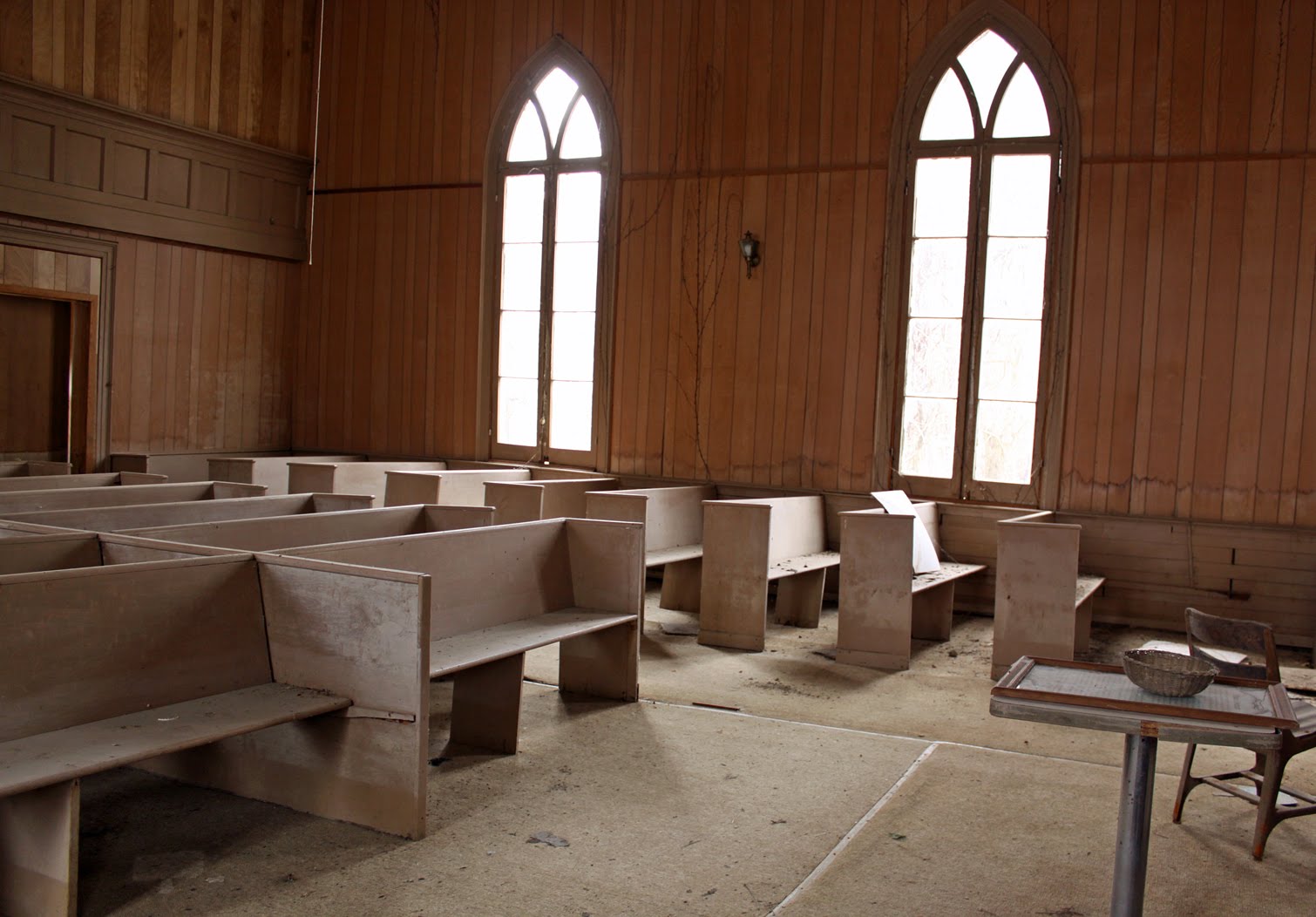

However, I did find a couple of things of interest. Down front, there was a pedestal table with a framed document lying on top of it.

As I got closer, I saw that it was the Church Covenant, and sitting on top of it was an offering basket with a few dollar bills and some change in it.

It gave me chill bumps to think about the goodness of the people who had left the offerings at that old abandoned church. I wondered if they were from the area around Rodney, or if, perhaps, they were visitors who had heard about Rodney, and took the time to see it for themselves.
I also noticed these dusty flowers and wondered about the person who put them there.


As we left the church, I stood there for a moment taking in the surroundings, and found it difficult to comprehend that what I was seeing was once part of a thriving cultural center on the Mississippi River.
The town wasn't deserted, and can't really be called a "ghost town," because there are still a few people living there, along with numerous deer camps scattered around the area. A lot of the old buildings have caved in or fallen down, and the ones left standing appear to be on the verge of disappearing into the landscape, too.


The building appears to have had a balcony and porch at some point in time.


The Mississippi Lodge #56 of the Free and Accepted Masons was located in Rodney from the 1850's to the 1920's, and, during Rodney's heyday, it was not unusual for traveling thespians on the showboats to use the Masonic Hall for their performances.
Sadly, here is the lodge as it looks today ...

I'm going to end this chapter here at the Masonic Lodge, but tomorrow I will take you across the street to explore one of the oldest surviving churches in Mississippi, the Rodney Presbyterian Church, circa 1830-31.

We will also climb to the top of the steep bluff behind the church to visit the old Rodney Town Cemetery. I hope you will join me tomorrow ... for the best part of the adventure is yet to be!


