My husband and I recently spent a couple of days exploring the heart of Cajun Country in South Louisiana, and one of my favorite places we visited was Avery Island.
Avery Island is actually the tip of a subterranean mountain of salt thousands of feet deep, three miles long and two and a half miles wide, and is surrounded on all sides by bayous, salt marsh, and swampland.
The Island's "claim to fame" is being home to the McIlhenny Tabasco Sauce Factory, where they have been making the famous sauce for over 125 years.


Tours of the factory are given Monday through Sunday and admission is free. There is also a Tabasco Country Store where you can enjoy some hot and spicy ice cream!

Our time was limited, so we decided to explore the island's Jungle Gardens, instead of touring the Tabasco factory. But before I begin my tour of the gardens, I'd like to share a little of its history:
Born on Avery Island in 1872, Edward McIlhenny was an arctic explorer, naturalist, and conservationist. He studied the plants and animals on Avery Island and in the surrounding salt marshes, and in 1895 he founded "Bird City," a private bird sanctuary for the once-endangered snowy egret.
The son of Tabasco sauce inventor E. McIlhenny, "Ned," as he was affectionately known, assumed the presidency of McIlhenny Company in 1898, and ran the world-famous pepper sauce operation until his death 51 years later.
In the 1920s, however, Ned found time to convert his private Avery Island estate into Jungle Gardens, decorating it with exotic botanical specimens from around the world. He gradually expanded the gardens until it reached its present size -- more than 170 acres.
Under the Avery/McIlhenny family's management, Avery Island has remained a natural paradise, inhabited by many animal species, as well as exotic plants from throughout the world.
Jungle Gardens has a five-mile drive through live oak groves, along man-made lagoons teeming with plant and wild life, through an arch of old wisterias, inside an extraordinary row of hollies and a garden grove of camellias. You can also visit a 900-year-old Buddha and an ancient oak tree over 300 years old.
Now for the tour of the gardens as they looked on the hot, sultry August day when we visited them. I can only imagine how they look in the springtime when the azaleas, irises, wildflowers, and wisteria are in bloom.
The first stop we made was to capture some pictures of the magnificent moss-draped Southern Live Oaks.


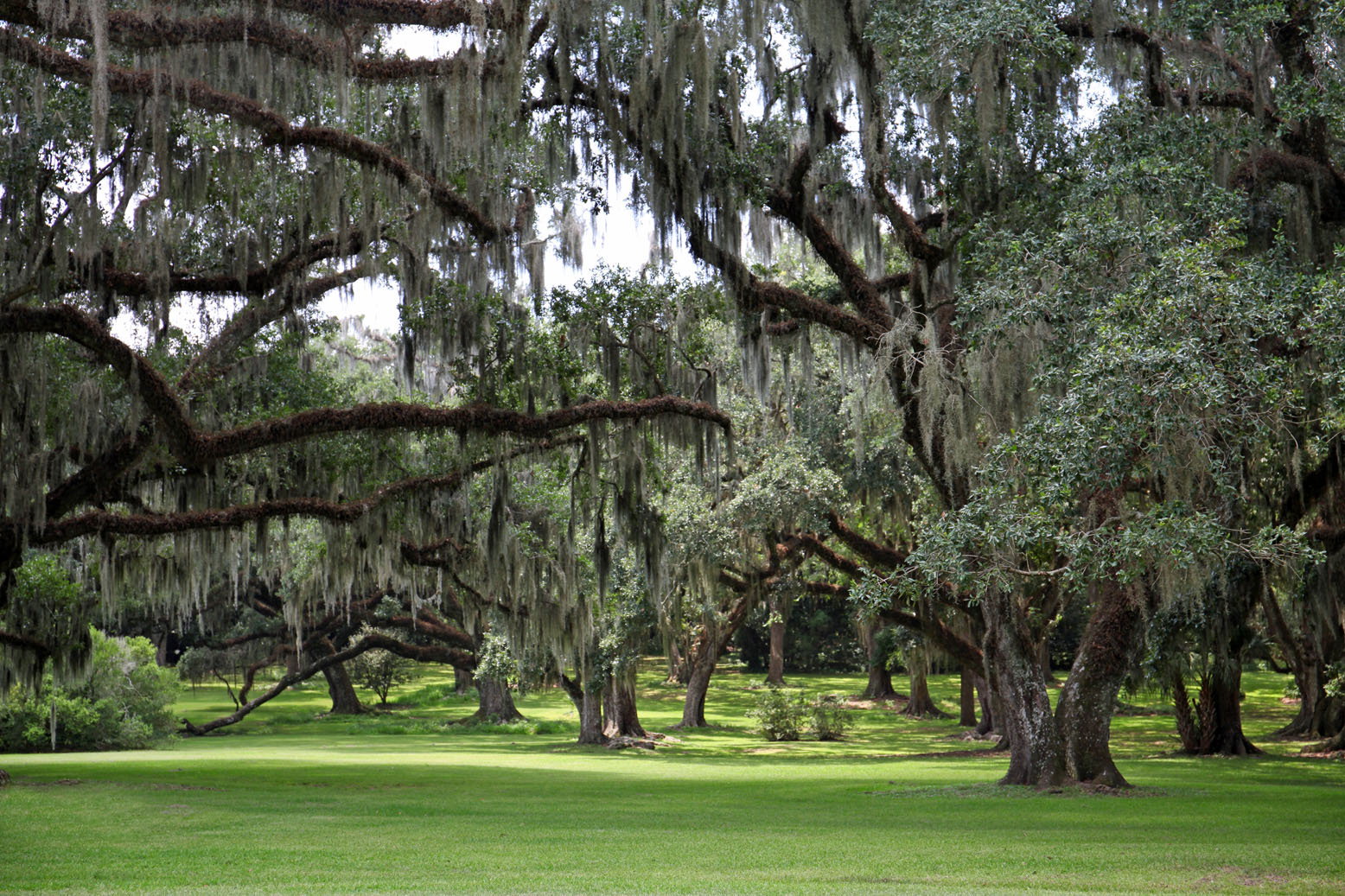
My pictures don't begin to do the oaks justice ... they were truly majestic. I was born and raised in Louisiana, and I don't remember ever seeing Spanish moss as heavy as it was on those old oak trees.


I so wanted to get a picture of one out of the water, but I guess it was too hot even for the alligators to be out that day. When we pulled over and stopped beside the bayou, I was excited to see a gator swimming straight towards me.

I quickly switched to my long lens camera so I could stay a safe distance from him.


The brochure we received before we began our tour cautioned about feeding the alligators. I later read that they love marshmallows because they look like egret eggs, and they gobble up both in a snap (no pun intended)!
I have to admit that it was a little scary standing less than eight feet away from an alligator ... even though he wasn't but around five feet long ... and I quickly changed my mind about wanting to get a picture of one out of the water. I was happy to see one that close, but I wanted him to stay in the water, lest he mistake me for a marshmallow.
The following pictures are of the marsh trail where you are most likely to find alligators ...


Our next stop was a little more comfortable since we didn't have to be on the lookout for alligators. This is the ancient oak tree I mentioned earlier ...


Named for President Grover Cleveland, who visited the McIlhenny family and this tree around 1891, the Cleveland Oak is over 300 years old.
Another interesting and very old tree in the gardens is the Survey Tree. Survey trees, or witness trees, are used by surveyors to mark the corners of a tract of land.


Another interesting and very old tree in the gardens is the Survey Tree. Survey trees, or witness trees, are used by surveyors to mark the corners of a tract of land.


I believe the live oak referred to on the plaque at "Point A" is the Cleveland Oak.
This beautiful Holly Arch was planted during the 1920s ...
This beautiful Holly Arch was planted during the 1920s ...

I would love to see the Wisteria Arch in the Spring ...

Our next stop was to visit The Buddha.


I was disappointed that I couldn't get a full picture of him, but can certainly understand why he is encased in protective glass.

The following plaque explains how the 900-year-old Buddha ended up at Avery Island, Louisiana.

The following is a beautiful tribute to Buddha written by Edward McIlhenny ...

The Palm Garden was once an old mining sand pit. Ned planted palms and cacti here because of their love of sandy soil ...

I almost ran into a rather intimidating-looking creature while taking the picture of the Palm Garden. I surely am glad I saw him in time to capture him (or her?) with my camera instead of in my hair [shudder!] ...

By this time, the hot and sultry weather had taken its toll on me and we skipped touring Bird City. I'm sure the egrets and herons were probably huddled in the shade of one of those old oak trees, or perhaps gathered under the branches of the cedars ...


Our last stop on the tour was my favorite (or maybe a tie with the alligators), and I spent a good bit of time exploring and capturing pictures of the Timber Bamboo.


Imported from China, Timber Bamboo grows a foot or more a day, and is fully grown in 65 days! Maybe the creaking sound I kept hearing was the bamboo growing.


You can tell I really liked the bamboo by the number of pictures I took.


We enjoyed seeing Avery Island, and I'm sure every time we see a Tabasco bottle in a restaurant now we will be pleasantly reminded of our visit. If you are ever in South Louisiana, I hope I have inspired you to explore the Island for yourself, and, if possible, plan your visit for Spring when the flowers are blooming. A word of caution, though -- leave the marshmallows at home.
For more information about Avery Island, you can visit the Avery Island website: