Showing posts with label kudzu. Show all posts

Monday, September 26, 2011

Mexican Petunias

We visited my parents over the weekend at their home in northeast Louisiana, and enjoyed sitting on their back porch watching the antics of their hummingbirds as they swarmed around two feeders. I'll share a few of the pictures I captured of the hummers later this week, but today I'd like to share these colorful Mexican Petunias (ruellia brittoniana), which are growing in a flower bed near their porch.

Mexican Petunia is a perennial shrub that grows to be about three feet high and three feet wide.
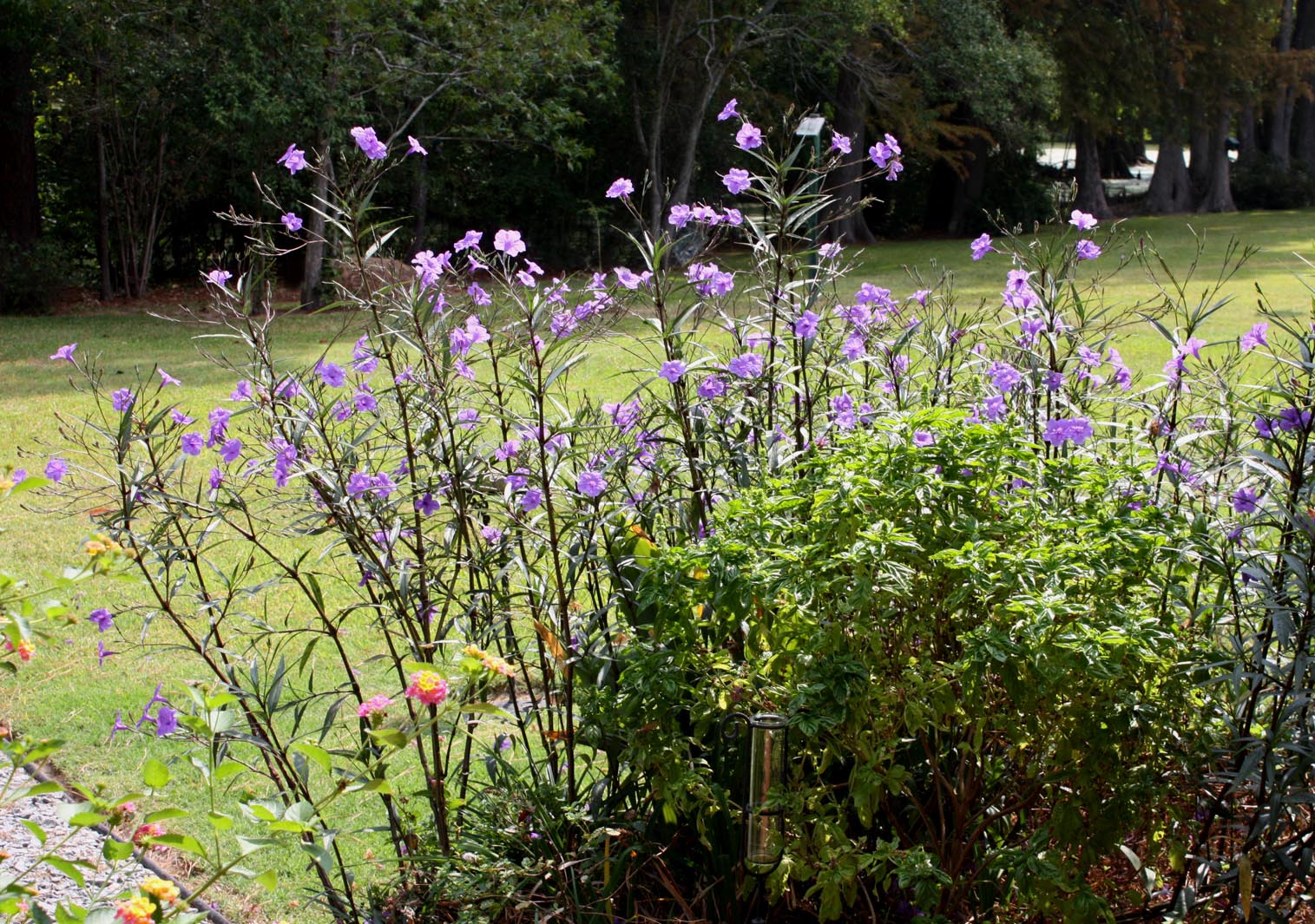

When grown under hot sunny conditions, the foliage assumes a metallic bluish cast.

The flowers are trumpet-shaped, and between one-and-a-half and two inches in diameter.

They can be white, pink, purple, or any shade of blue, but I've never seen any color but the bluish-purple. The flowers bloom profusely during the hottest part of the year, and butterflies love them.

This is a picture of my Mexican Petunias which I took a couple of years ago. If you look closely, you can see butterflies in and amongst the blooms.

The plant is native to Mexico, but it can be found throughout the southeastern United States. Unfortunately, in some places, like Florida, it has been declared invasive.

Invasive or not, I love Mexican Petunias — but, then, I love Morning Glories ...

Chinese Tallow Trees ...

Honeysuckle ...

Kudzu ...

And Clover, too!

Thursday, July 3, 2008

New Orleans Trip -- The FINAL Chapter

Before leaving the city, we decided to tour the Garden District and Magazine Street. The Garden District looked pretty much the same as it did before Katrina, with the exception of some new construction or renovations under way. The St. Charles trolleys were running and it was good to see that the old oak trees lining the boulevard survived.

Here are a couple of houses I was able to photograph as we were driving through the Garden District on our way to Magazine Street ...

The shops on Magazine Street were closed Sunday morning, but there was so much traffic and cars lining the street that it was difficult to get any decent photos. I'm probably in the minority, but I really don't care for the shops on Magazine. I much prefer little out of the way flea markets, antique malls, and "junk" shops.

After we drove up Magazine Street, we said our farewells to New Orleans and headed for I-10 and home.

As I mentioned in Chapter 1 of this epic, we stopped at Middendorf's at Manchac again for lunch and then decided to go through Natchez on the way home.

In Natchez, we stopped at Fat Mama's Tamales, to pick up some hot tamales. Fat Mama's claim to fame is her "Knock You Naked Margaritas." I don't know about the margaritas, but her hot tamales will knock your socks off.

I also took time to get this picture of the Mississippi River bridge at Natchez. By the way ... that's kudzu in the foreground (if you don't know what kudzu is, please see my post called, "The Art of Kudzu").

From Natchez, we took the Natchez Trace which was a nice change of pace. My husband loves to drive the Trace -- the speed limit is 50, and there is relatively little traffic on it. He can just relax and enjoy the peace and tranquility of scenery like this ...

The town of Port Gibson was our next stop because it has one of those "pictures just begging to be taken," and I wanted to take it. Located between Natchez and Vicksburg, Port Gibson has many historic buildings that survived the Civil War because Grant believed the city "too beautiful to burn." It is home to the beautiful First Presbyterian Church, circa 1859, which has a very unique steeple featuring a large gold hand pointing toward Heaven ... not something you see everyday!

Well, the next stop was Vicksburg and home where we had a "surprise" waiting for us. If you'd like to hear the rest of that story, please read my "A Soggy Homecoming" post.

I hope you enjoyed our trip to New Orleans as much as we did. I'm sure we'll be going back again sometime, perhaps in the fall when it cools off some. I promise I won't write another novel about it, though.

Sincerely,

Monday, June 16, 2008

The "Art of Kudzu" ...


I was born and raised in the South, where the word "kudzu" becomes part of a child's vocabulary probably at the age of three or four when they say, "Mommy (or Daddy), look at that big green dragon!" ... to which Mommy or Daddy replies, "Oh, that's not a dragon, that's kudzu."

Kudzu, which originated in Japan and China, was introduced to America in 1876 at the United States Centennial Exposition. It was originally presented as a decorative garden plant. In the 1930's, the U.S. Department of Agriculture planted thousands of kudzu seedlings along roads and hillsides to prevent erosion and it has had a strangle-hold on the South ever since.

I've always been fascinated with the amazing phenomenon called kudzu and appreciated the artful and eerie way its creeping vines drape over trees, power lines, old abandoned cars, barns, and houses, literally swallowing everything in its path. [See pictures below] In the summertime, its deep green leaves look so cool and inviting, and its pretty reddish-purple blooms are intoxicatingly fragrant. So, why does just the word kudzu strike fear and dread in the hearts of so many southerners? Please keep reading.

Kudzu Facts:

The roots of the plant may go more than twelve feet deep. The vines can grow a foot in length a day, and more than sixty feet over the course of a summer. Multiply that by lots of vines on lots of plants and you can see why kudzu is considered "the plant that ate the South." It's also known as the "mile-a-minute vine," "foot-a-night plant," and "cuss-you plant." In Mississippi alone, kudzu covers over 250,000 acres--and that's a lot of land that could be put to better use.

Almost anywhere south of the Mason-Dixon Line, you can find the vine growing on utility poles, fences, trees and anything else that doesn’t move.

Yet, even with its destructive reputation, kudzu is something of a cultural icon for the South. There is a restaurant in Atlanta named after it, a comic strip written & illustrated by Doug Marlette called “Kudzu,” and a southern rock band goes by the name Kudzu. James Dickey, the renowned southern poet, wrote a dark poem about the vine, called appropriately enough, “Kudzu.”

Kudzu is now common throughout most of the southeastern United States, and has been found as far northeast as Paterson, New Jersey, in 30 Illinois counties, and as far south as Key West, Florida. It was also found growing (rather inexplicably) in Clackamas County, Oregon in 2000.

Above information excerpted from Wikipedia and
Kudzu Chaos, by Jennifer Holloway Lambe


I thought it would be fun to share some of "the art of Mississippi kudzu" with you, so I grabbed my camera and headed out to explore the closest kudzu infestation, which is about eight miles from my house. Here are a few of the more interesting kudzu formations I discovered.


If you look closely at the picture below, you can see a school bus in the background which has almost been totally covered with kudzu.

It was kind of an eerie feeling standing so close to these creeping kudzu tendrils. They seemed to be easing closer and closer to my feet, reaching out like the tentacles of an octopus, and I didn't spend but a minute there.

O, Christmas Tree, O, Christmas Tree ...

The road to nowhere ...

I had a neat idea after I got home from taking the pictures, and I may go back one day soon and try it. [Most of my good ideas usually happen after the fact.]

I'm going to go early one morning and put a flag at the end of one of the kudzu tendrils and then go back at the end of the day and see how much it grew. Should be interesting ... and I'll take pictures to show you.