Showing posts with label Photos of Vicksburg National Military Park. Show all posts

Monday, February 4, 2013

Farewell to Winter

I am already looking forward to the arrival of Spring, but, unfortunately, we still have several more weeks of winter to endure before it makes an appearance here in Vicksburg. In the meantime, I thought it might be fun to go out and capture with my camera some of our winter landscapes and scenery, which have a beauty all their own ... and I didn't have to venture far from home to find it.

I drove over to the Vicksburg National Military Park, which is about ten minutes from our house, and I was able to capture most of these pictures from my car, with the exception of the closeup shots.

It was a mostly overcast day and the magnificent magnolias, gingkos, and oaks in the National Cemetery made magnificent silhouettes against the gray skies ...

The next two pictures are of the massive trunk of my favorite old gingko tree in the cemetery. Just look at the character in its strong rugged bark ...
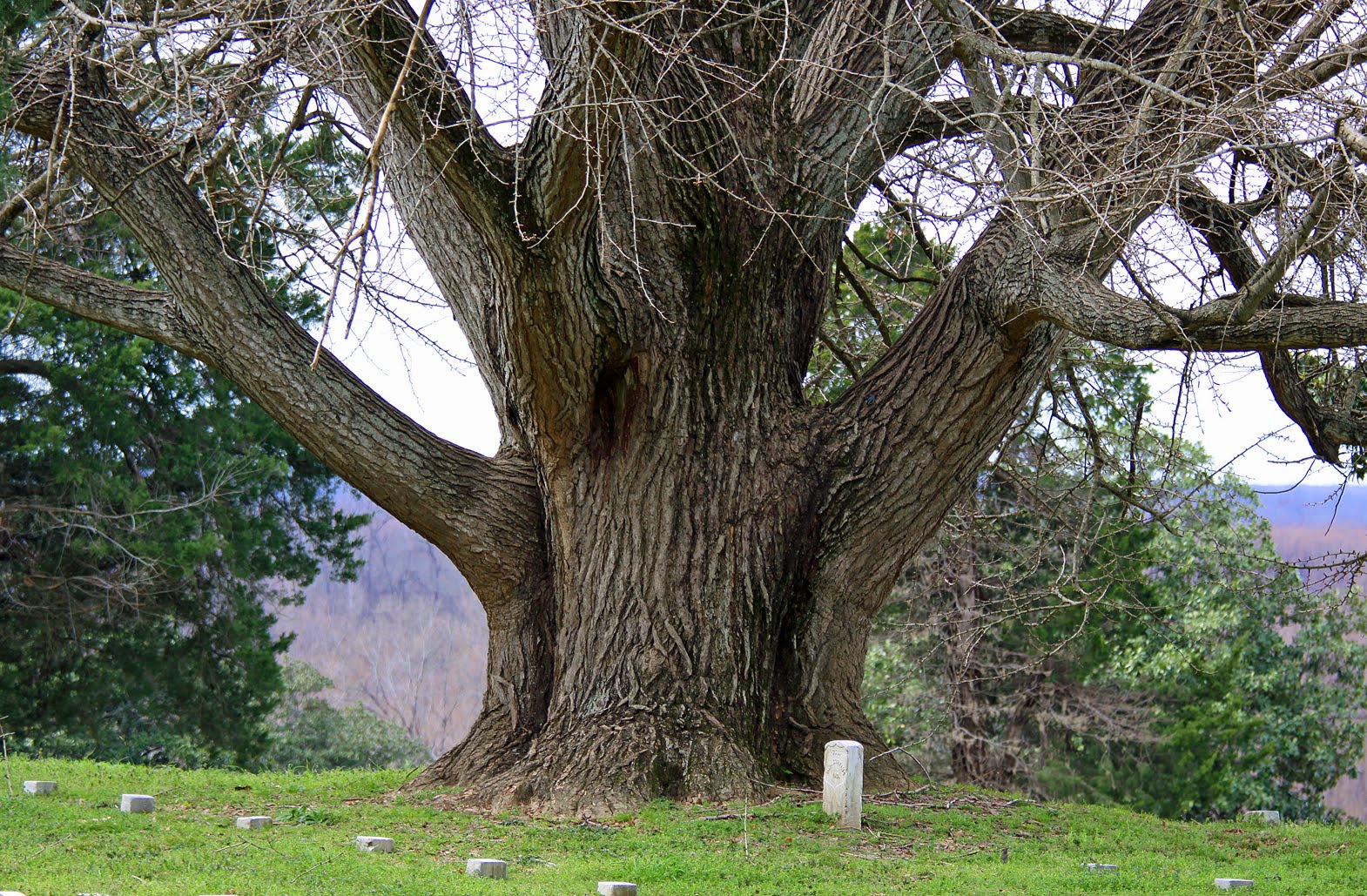
I love that old tree!

I spotted this redbird resting in the branches of a cedar tree not far from the old gingko.

He was a long way off, but I managed to capture the picture from my car with my zoom lens. I love the contrast of his crimson feathers against the green cedar branches.

Just outside the cemetery is Fort Hill.

Fort Hill was the highest elevation in Vicksburg during the time of "The Siege."

As I followed the winding roads through the park, I noticed things that you don't see during the Spring or Summer. Like the tangled vines of honeysuckle and briars ...

And bright green carpets of moss growing along the sides of the road ...

A hole in the trunk of a tree caught my attention, and I used my zoom lens to get a closer look.

As you can see, the hole is out of focus, but I think it turned out to be a much more interesting picture, with the focus ending up (albeit, by mistake) on the sweetgum balls instead of the hole (you can click on the image to get a closer look, if you'd like).

All along the roads were winter grasses, with their pretty rust-colored plumes brightening the landscapes ...

And speaking of "brightening the landscapes," as I left the park, I did a double take as I passed by these colorful purple Irises planted in front of a weathered cedar shake wall ...

I'm still working on my macro skills, and found this lovely little bouquet of "springlike" jonquils a delightful subject to practice on ...

Although I was practically standing on my head to get these pictures, I deemed them to be "keepers."

As well as these delicate little snowbells ...

My lagniappe for the day was this picture of a tugboat on the Yazoo River Diversion Canal ...

It wasn't until I was editing the picture that I realized it was the tugboat that made national news last week when it pushed its load of barges into the railroad bridge crossing the Mississippi River at Vicksburg, causing an oil spill and tying up river traffic for several days.

I"m not sure this turkey could be called lagniappe, but he didn't stay around long enough to pose for a picture.

Overall, I guess you could describe our Mississippi "winterscapes" as drab and blah, but I enjoyed capturing and preserving some of the beauty I found in and amongst the drabness, as I bid farewell to winter and look forward to welcoming Spring's arrival.

Monday, February 14, 2011

Seasons of a Gingko

I love trees — especially OLD ones — and my all-time favorite tree (even more so than the Friendship Oak on the Mississippi Gulf Coast) is the 250+* year-old Gingko Tree in the Vicksburg National Cemetery. I have visited it often since we moved to Vicksburg over four years ago, and never cease to be humbled and awed in its presence, as it is truly One of God's Masterpieces.

It occurred to me the other day that I have photographed it in the summer ...

And lots of times in the Fall when it was at its most glorious (you can click on the pictures to enlarge them, if you'd like to get a closer look).

But for some reason, I've never photographed the tree during the Winter or Spring.

One day last week, I realized that if I was going to capture it during the winter, I'd better do it soon, so I set out to do just that. I drove over to the park and was pleased to see some light patches of snow still on the ground from a recent snowfall. Even though it made for some treacherous footing on the slopes, I think it added interest to the pictures.

I love that massive old trunk. It is truly awe-inspiring to reach out and touch it and think of the history it witnessed.

I will go back in the Springtime and capture this majestic Gingko once more — in all its splendor — as its new leaves unfold.

* Postscript:

Just a note to follow up on the age of the tree. I'm disappointed to have to say that I was misinformed on how to determine the age of a tree. I received the following e-mail dated 7/26/2011, from Ms. Virginia DuBowy, Natural Resources Program Manager of the Vicksburg National Military Park:

I read with interest your internet article in Southern Lagniappe on the large ginkgo tree in Vicksburg National Cemetery. Unfortunately, the tree is not as old as people assume. There have been several tree surveys done in the cemetery over the years, with the first map done in 1917. There is no ginkgo tree shown on this map on the site of the current tree. It does however, appear on the next survey done in 1933, where it is listed as being 18 inches in diameter at breast height, 30 feet tall, and having a crown spread of 25 feet.

So, it appears that this tree did not get planted until sometime after 1917, and therefore was not around during the siege of Vicksburg, much less 1775. Also realize that when the cemetery was established in 1866, the ground was graded and terraced extensively, and much of the vegetation was not planted until after the burials were completed.

Thank you for highlighting the wonderful trees that are maintained in the national cemetery, and I agree that the ginkgo in its full golden color is probably one of the most beautiful trees I've ever seen.

Virginia S. DuBowy
Natural Resources Program Manager
Vicksburg National Military Park

Thursday, September 2, 2010

The Ladies of the Park

One of my favorite places to visit in Vicksburg is the Vicksburg National Military Park, which commemorates the campaign, siege, and defense of Vicksburg during the War Between the States. It is truly one of Mississippi's greatest historical treasures, and I have spent many memorable hours there photographing its beautiful monuments and awe-inspiring landscapes.

Today, I'd like to present "The Ladies of the Park," which are the state monuments that feature magnificent sculptures of women (you can click on the pictures to enlarge them if you'd like to see the amazing details up close).

The first monument I would like to share is the Mississippi State Memorial.

Gracing the monument's front is a bronze statue portraying Kleio, Muse of History, who is holding an open scroll on her lap.

The Mississippi Memorial is constructed of Mount Airy, North Carolina granite, and was erected at a cost of $32,000. Standing 76 feet high, the bronze work was fabricated in Rome, Italy, by renown sculptor Frederick Triebel. The bronze work represents various actions of the Mississippi troops during the Siege of Vicksburg.

My next stop was at the impressive Missouri State Memorial.

The 42-foot monument features a bronze angel which represents "The Spirit of the Republic." The sculptor was Victor S. Holm.

The memorial was erected at a cost of $40,000, and it is unique in that it is the only state memorial on the battlefield dedicated to soldiers of both armies. The height is symbolic of the forty-two Missouri units -- 27 Union and 15 Confederate. It stands where two opposing Missouri regiments clashed in battle, which I find fascinating.

The next elegant "Lady of the Park" is found at the Michigan State Memorial, and she signifies "the Spirit of Michigan." The sculptor was Herbert Adams, and the 37-foot monument is made of White Bethel Granite.


I've saved my favorite lady for last. She can be found at the Minnesota State Memorial, and represents the "Statue of Peace." She is holding a sword and shield from both armies who placed their weapons in her keeping.

The ninety-foot vertical column is made of Mount Airy, North Carolina granite, and was erected at a cost of $24,000. The sculptor of this magnificent statue was William Couper.

I can only imagine the visions and God-given talent that went into capturing forever in stone these beautiful "Ladies of the Park."

I never tire of exploring the Vicksburg National Military Park, and I always discover something interesting that I haven't noticed on previous visits.

If you would like to see some of the other pictures I've captured of the park, you can view the slide show presentation below. I created it in 2009, and it includes several detailed photos of the monuments. The music accompanying the slideshow is "A Call to Arms," which I think serves as a dramatic background for the photos.

Click to play this Smilebox slideshow